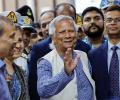
Muhammad Yunus proved that he was neither an armchair economist nor a slogan mongering political activist, but a doer destined to do what Mahatma Gandhi said -- to remove every tear from every eye, recalls Rup Narayan Das.

Yunus, 70, said he was relinquishing his post to prevent undue disruption of the bank's work.

Nobel Laureate Muhammad Yunus, whose experiment of poor men's banking in Bangladesh helped establish micro-credit movement across the developing world, will address the Indian Parliament in December this year.

Muhammad Yunus on Thursday promised to deliver a government which assures safety to its citizens, as the Nobel laureate returned to the protest-torn Bangladesh from Paris to take oath as the head of the interim government following the ouster of Sheikh Hasina.

'f you think you will leave the country after two months, it won't be possible'

Relations with India experienced a downturn during Yunus's tenure, while ties with Pakistan saw positive developments.

Bangladesh has not yet decided on Prime Minister Tarique Rahman's visit to India for the upcoming BRICS summit, with his office stating that Dhaka is awaiting New Delhi's response to its request for the extradition of deposed prime minister Sheikh Hasina and other 'fugitive criminals' currently residing in India.

Exiled Bangladeshi author Taslima Nasreen has drawn a parallel between the CJP-led protest in Delhi and the 2024 student movement in Bangladesh that ousted Sheikh Hasina's regime, warning that the Bangladesh stir 'fooled us' and was ultimately taken over by 'jihadis'.

India is currently examining Bangladesh's request for the extradition of former prime minister Sheikh Hasina, who has been living in India since her government's collapse in August 2024, with New Delhi confirming the issue is being processed according to established procedures.

Professor Yunus is in New York, accompanied by young Bangladeshis who led the student uprising against Hasina, and the bon homie he shared with two US presidents, current and past, will add masala to the conspiracy theorists.

Sheikh Hasina, Bangladesh's deposed prime minister, has accused the interim government led by Muhammad Yunus of committing atrocities against non-Muslims and interfering with religious freedom.

A parliamentary committee has noted Bangladesh's extradition request for former prime minister Sheikh Hasina, who faces a death sentence in absentia. The Indian government has confirmed the request is under examination, reiterating its humanitarian approach of offering refuge while ensuring no political activity is conducted from Indian soil. The committee has urged the government to keep it apprised of the matter.

'The strain you are witnessing is entirely of Yunus's making. His government issues hostile statements against India, fails to protect religious minorities, and allows extremists to dictate foreign policy, then expresses surprise when tensions rise'

Veteran politician Mirza Fakhrul Islam Alamgir has been sworn in as Bangladesh's 23rd President, following a contested parliamentary election that saw him defeat Colonel (retd) Oli Ahmed. Alamgir, a longtime secretary general of the ruling Bangladesh Nationalist Party (BNP), will serve a five-year term.

'You empower a man, you are not necessarily empowering a family, you are just empowering him.'

Bangladesh Chief Adviser Dr Muhammad Yunus paid tribute to Dr Manmohan Singh at the Indian high commission in Dhaka.

'There is no substantive basis for Bangladesh-Pakistan relations. The only real link they can have is mischief, with Pakistan's intelligence agency using Bangladesh to create trouble along our eastern borders.'
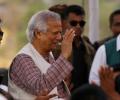
Bangladesh Chief Adviser Muhammad Yunus has said that his interim government wanted good relations with India, but 'something always went wrong'.

Bangladesh's Chief Adviser Muhammad Yunus announced that the next general election will be held in February 2026, marking the first anniversary of the 'July Uprising'.
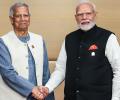
Bangladesh's interim government chief, Muhammad Yunus, has raised the issue of ousted prime minister Sheikh Hasina's extradition from India during a meeting with Prime Minister Narendra Modi in Bangkok. However, Indian officials have denied that the extradition request was discussed. The meeting has sparked controversy with differing accounts of the discussions.
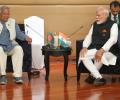
In his post, an official claimed that Modi had said: "We saw her (Hasina's) disrespectful behaviour towards you (Yunus).

Bangladesh's deposed Prime Minister Sheikh Hasina congratulated Suvendu Adhikari on assuming office as West Bengal's Chief Minister after the BJP's victory in the state.

Dinesh Trivedi's success or failure in this fragile diplomatic equilibrium will have consequences extending well beyond the Indian high commission in Dhaka. It will shape India's eastern strategic environment for years to come.

India's position appears to be anchored around three red lines: Hasina's safety and the guarantee of a fair trial; assurances that Bangladeshi territory will not be used for activities hostile to India; and the restoration of an inclusive democratic process in Bangladesh.
A former Bangladesh army officer and close aide of Chief Adviser Muhammad Yunus has suggested that Dhaka should collaborate with China to occupy India's northeastern states if it attacks Pakistan in response to the Pahalgam terror attack. Bangladesh's interim government has distanced itself from the remarks made by Major General (Retd) ALM Fazlur Rahman on his social media account. Rahman's comments come amidst growing tensions between India and Bangladesh following Yunus' remarks in China about India's northeastern states being landlocked and needing Bangladesh's access to the ocean. These incidents have further strained relations between the two countries, with India withdrawing transhipment facilities granted to Bangladesh for exporting goods to the Middle East, Europe, and various other countries.

Yunus's office, meanwhile, reconfirmed that financial and welfare assistance would be provided to Das' family, and relevant authorities would remain in close contact with them in the coming period.

Former Union minister Dinesh Trivedi has been appointed as India's next High Commissioner to Bangladesh, signalling efforts to strengthen bilateral relations between the two countries.

The brother of slain Bangladeshi radical leader Sharif Osman Hadi has alleged that a faction within the interim government plotted his brother's killing to disrupt the upcoming general election. A special assistant to the Chief Adviser has resigned following the allegations.
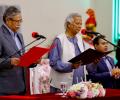
Bangladesh President Mohammed Shahabuddin administered the oath of office to 2006 Nobel Laureate Muhammad Yunus as head of the country's interim government at the Bangabhaban in Dhaka.
Bangladesh's interim government chief Professor Muhammad Yunus is considering resigning after political parties failed to reach a common ground, according to the National Citizen Party (NCP) chief. Yunus, appointed after a student-led uprising toppled the previous government, expressed concerns about his ability to function in the current political climate.
India has exempted Bangladeshi exports to Nepal and Bhutan as such trade facilitation is mandatory for landlocked countries under the framework of provisions of the World Trade Organisation (WTO).

Beijing clearly intends to extend the China-Myanmar Economic Corridor to Bangladesh as part of its larger Maritime Belt and Road Initiative to boost its Indian Ocean presence.
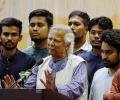
Yunus said his administration took over to carry out three mandates 'justice, reform and elections.'
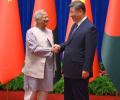
Bangladesh's Chief Adviser Muhammad Yunus has called upon China to expand its economic influence in Bangladesh, controversially mentioning that India's northeastern states being landlocked could present an opportunity. Yunus, who recently visited China and met with President Xi Jinping, highlighted Bangladesh's role as the "only guardian of the ocean " in the region, suggesting it could be a pathway for Chinese economic expansion. This statement has sparked debate, with Sanjeev Sanyal, a member of Prime Minister Narendra Modi's economic advisory council, questioning the relevance of India's landlocked states in Yunus' appeal to China. Yunus, however, emphasized the importance of a strong friendship with China, viewing it as a counterbalance to India. During his visit, Yunus signed nine agreements with Beijing and secured USD 2.1 billion in investments, loans, and grants from the Chinese government and companies.

He was sleeping in a garage when the fire broke out, and CCTV footage suggests foul play.

Witnesses said the police in riot gear turned tough as the protestors tried to break through security barricades in front of Jamuna from a nearby sit-in demonstration, defying the earlier announced ban on rallies adjacent to Jamuna.
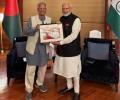
In his first meeting with Bangladesh Chief Adviser Muhammad Yunus, Prime Minister Narendra Modi on Friday flagged concerns over the attacks on minorities, including Hindus and conveyed that any rhetoric that vitiated the environment was best avoided.

India has decided to withdraw the families of Indian officials posted in Bangladesh due to security concerns ahead of parliamentary elections. The move comes as a precautionary measure given the increasing activities of extremist elements in the country.
'It was the hostility of the Yunus regime that made India careful and wary of dealing with them.' 'They gradually backed off and lowered the noise, but the damage was done.' 'Their true colours had been exposed.'

Bangladesh held its 13th general election on February 12, 2026, with voters across Dhaka casting ballots in a significant democratic exercise.
